America's Heartland
HomeStoriesRecipes & TipsScheduleEducationBlogAbout The ShowAg in Your StateShop
 
Episode 118

Cotton to Denim

Cotton to Denim

Cotton to Denim

Cotton to Denim

Cotton to Denim


Whole Cloth Watch Video

You know, farming is like any business. To stay profitable and competitive, you have to find new, more efficient ways to create your products.

That’s what our Pat McConahay found in Lubbock, Texas, where a group of clever cotton growers not only plant the fields and pick the crop, they own the nearby factory that turns it into denim— a fabric used to make some of the world’s most popular fashions.

In that factory are machines turning out one of the most widely used fabrics in the world—denim. Chances are your favorite pair of jeans started out in a cotton field in Lubbock Texas.

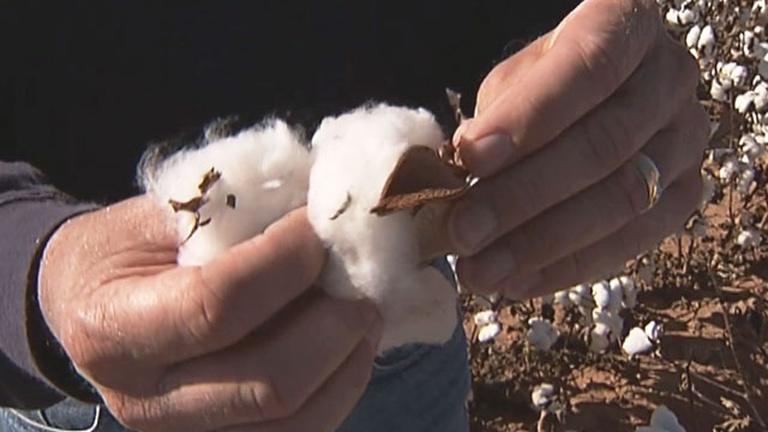
Recently, Pat and Texas cotton grower Dahlen Hancock walked through one of his fields. It had been a pretty good year weather-wise, the bolls were opening up, and the harvest looked promising.

That’s all good news for Dahlen, a 4th generation cotton grower. He’s a member of the Plains Cotton Cooperative Association, the world’s largest producer and supplier of Texas-style cotton. It’s also the only farmer-owned cooperative that owns its own denim manufacturing plant – so what’s picked in the field one day, could be fabric the next

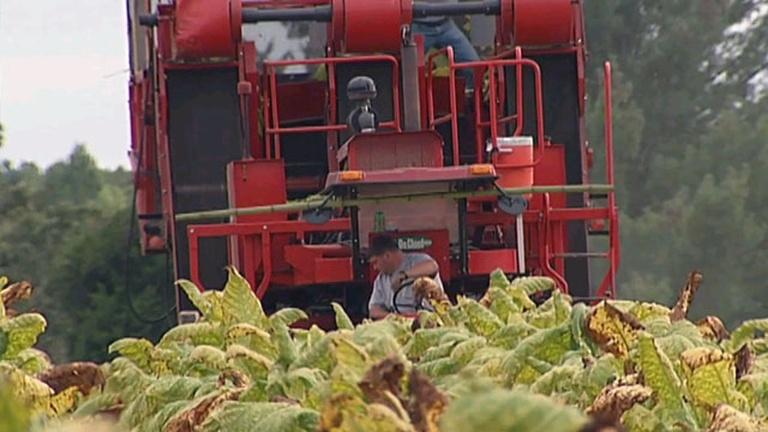
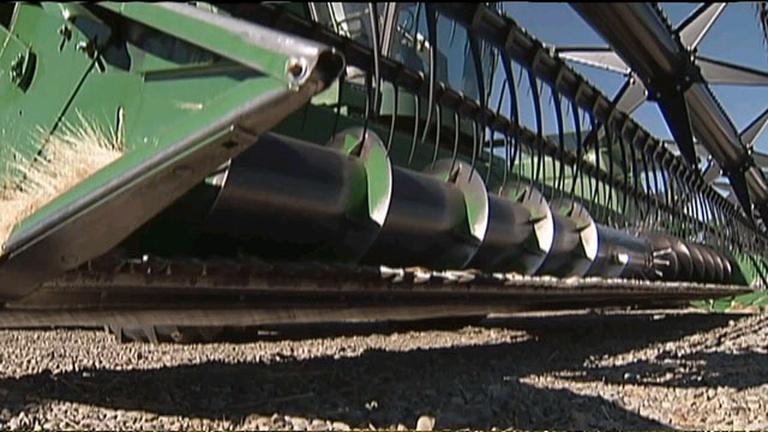
But the denim story actually begins back in the field. The cotton picker has made the fall harvest a lot easier than in the days when people picked cotton by hand. "It takes in eight rows at a time," said Dahlen. "It has some little bats and brushes. By that I mean little rubber bats and brushes that actually wipe the cotton and it brushes and it takes it off the plant."

A combination of saws and brushes extract the cotton from the burr. The cotton, or lint, is dumped into what’s called a boll buggy and taken to an area where it’s packed into what looks like huge loaves of bread with wrappers on top.

The cotton is sucked into the building through powerful pipes that send it through various cleaning processes to remove dirt, leaves and even plastic that may have wound up in the field.

Next the seeds are removed from the lint so the fiber can be made into your next pair of jeans. And that happens at a textile plant that’s not too far from Dahlen Hanson’s cotton field. The co-op was formed in 1953 to help farmers get the best price for their product. About 20 years later, members wanted to do even more to boost their agricultural operation.

"Back in the 1970’s many of our farmers realized the cotton they produced was going into denim," says Wally Darneille, president and CEO of the Plains Cotton Cooperative Association. " And decided we should be producing a value-added product rather than just an agricultural, raw material. "

So they created American Cotton Growers Denim Mill in Littlefield, Texas, near Lubbock. Today the mill turns out enough denim to make 20 million pairs of jeans a year. Darneille says this plant is just one place where the cooperative’s cotton goes—but it’s an important one

"It has become such a competitive market now, with so many different countries getting into it that it’s still a profitable business for us, but not nearly as much as it was before," he said. " However, our members think it is important that we make a value-added product."

It’s a product that begins with the baled cotton being separated into small tufts and then blended with various cotton fibers. Darneille says this is one of the few mills where everything happens under one roof— spinning, weaving, dyeing, finishing, packing and shipping. It was conceived, and has become, a turnkey operation.

The denim is sent to Mexico or Latin America to be turned into apparel.

Darneille says there isn’t much difference between the quality of denim in a ten dollar pair of jeans and a 300 dollar pair—the difference is in the styling.

"We were in a factory the other day they spend 18 minutes making the perfect pair of jeans," he said. " Then they spend 32 minutes tearing it apart -- sanding it, sandblasting it, cutting it with scissors, doing all sorts of different things to achieve this vintage look."

It all helps make cotton the best selling fabric in America. As for the future, co-ops like this one are always looking for new ways to use that time-honored fabric. That’s good news for cotton farmers, whose product is still in demand worldwide.

Additional information:
www.pcca.com


The Monsanto Company and the American Farm Bureau Federation make presentation of America's Heartland possible.

Monsanto        Farm Bureau
Additional production and promotion assistance is provided by the American Soybean Association, National Corn Growers Association, National Cotton Council, United Soybean Board, U.S. Grains Council and National Association of Wheat Growers.


A production of KVIE, Sacramento, California. Distributed byAmerican Public Television
©2007 KVIE, Inc. All rights reserved.
Home | Search